Friday, May 3, 2013

Week 4: Olympic Peninsula

Date: April 27, 2013
Weather: cloudy, interspersed light rain
Temp: 50 F
Time: 1:00pm-6:30pm
Location: Olympic National Park

This weekend we changed locations. Our class packed up and set out to the Olympic Peninsula on the western side of Washington. This location is also home to one of the largest preserved remnants of old growth in the country and one of the only temperate rainforests in the world: Olympic National Park. Of course, when I say "old growth," I should point out, as one of the TA's from class explained, that old growth does not refer to the age of the forest, but rather the degree of complexity (that usually arises out of long term growth...). Old growth forests contain vegetation of varying sizes and ages and organisms within this forest tend to have have complex, intertwined  relationships with each other. This brings me to my topic for the week: Interactions. There are many types of interactions in an ecosystem, but I will focus on four of them: facilitation, competition, predation, and disturbance. As we strolled through the forests of the park, we observed the effects of these four interactions...

Facilitation
In my observations, this seemed to me to be the most commonly observable trend. This interaction exists between two organisms where one helps the other, and in the process either receives an exchange of benefits (mutualism) or is unaffected by the interaction (commensalism). The first relationship that becomes apparent in the rainforest is of an epiphytic nature. Mosses abound on trees, even hanging from their very branches, and ferns sprout in the upper crotches of trees. This is because, especially in rainforests, enough moisture hangs in the air that these plants can absorb water almost constantly and require only a little bit of organic matter to accumulate to be able to sprout and survive off the ground. Here, we see a shade-tolerant Dwarf Oregon Grape taking advantage of the bit of shaded area among these tree roots to keep out any sun-seeking competitors.
Shady business
Next, we saw one of nature's greatest, most specialized facilitations, insect pollination! We observed a bumblebee flying from flower to flower on a Salmonberry shrub.
http://www.nativebeeconservancy.org/wp-content/uploads/2012/04/Bee-on-salmonberry.jpg
Not my own picture, but you get the idea!
Another major factor that added lots of facilitative interactions and complexity to the forest was the presence of dead fallen trees called "nurse logs." As the name implies, they can be a beneficial presence for any forest ecosystem. Sometimes, trees grow their roots around them and sit on top of the nurse logs. This elevates them for both a height and light advantage as well as provides additional nutrients and water for the growing tree to feed on. Nurse logs and standing dead trees ("snags") can also provide a home for fruiting fungus species, an organism long known to have very intimate ties to both living and dead trees.
Mushroom colony!
 

One TA identified this as saddle fungus(?)
Artist's Conk:The disk-shaped fungus
usually seen on the sides of dead trees
If you look carefully, you can see
most of the bumps on this snag are Artist's Conk
 Competition
The second ecological relationship exists between two organisms that use the same resources to survive in nature. Here in the forest, in becomes apparent that competition for ground cover drives many vegetative plants to spread out horizontally as well as vertically. We saw two very common, abundant ground species. Salal was a very common ground species, found in nitrogen poor soils, while sword ferns tend to dominate nitrogen rich soils. A need to spread out horizontally has led to the evolution of "runners," or "stolons," which are stems that grow horizontally in order to sprout a new plant in an adjacent area. This can be seen in the Trailing Yellow Violet, viola sempervirens, which we saw much of lining the trail. This flower sends out runners and thus tends to grow in mats, which is something that can help distinguish it from the closely related Stream Violet, viola glabella (there was much debate over which species we were seeing since they look almost identical)
Viola sempervirens
Looks a lot like
Viola glabella
Another example of competition is the idea of successional forests. When a forest is disturbed in some way that eliminates much of the vegetation, plants have a set order to who will recolonize when, based on their life history traits that allow then to compete more efficiently for space, soil, and sun. Faster growers shade out slow, shade-intolerant species at first, until slow, shade-tolerant species arise.

Predation
Predation is the act of one species directly consuming another in order to survive. This may be a bit more difficult to observe; however, we did see two examples. One was what appeared to be a deer skull and a few random bones lying on the ground!


Didn't snap a picture, but it looked a lot like this!
Based on what we know about the local fauna, we can probably guess that it was a Mule deer (Black-tailed deer) that fell prey to either a fox or cougar.

Mule deer--look out little guy!
The second blatant example we were able to observe was this Douglas Squirrel who had found a delicious lunch of a female pine cone
While we did not see predation on this species, we also observed a Rough-Skinned Newt down by the stream! These have highly poisonous skin, and a bright orange underbelly to warn predators of this fact, in order to keep from being eaten.
 
Rough-skinned Newt. Poisonous, so be careful handling!
 

Disturbance
The fourth example of interactions deals with some disturbance outside the realm of normal ecosystem flux, in which a force, usually abiotic, that creates a drastic change in the structure or function of some components of the ecosystem. On the Olympic Peninsula, this usually takes the form of landslides or forest fires. Landslides can be common because of the Clawton Clay soil layer in the lower levels of the soil--water permeates to this clay then sit on top of it, causing up layers of soil to slide around on top of the clay. Fires can and have occurred in the Park and can cause new successions to occur. One Western Red Cedar we observed in the park showed charred bark as a legacy mark of the fire, but had actually managed to survive with most of the inner bark burned out of the center while the cambium still remained to continue growth!

Other species we saw in the park included both blue and white versions of the Forget-Me-Not flowers, Vanilla Leaf, several flowering Trillium, False Lily-of-the-Valley, Fairyslipper orchid, Orange Peel Fungus, a Raven, Stellar's Jay, Dark-eyed Junco, and Varied Thrush. See iNaturalist for my observations!

Date: April 28, 2013
Weather: cloudy, little wind
Temp: 50 F
Time: 10am-12pm
Location: Salt Creek Tideflats (Crescent Bay)

For our second day, we paid a visit to a more marine environment as we explored the intertidal zone of the Salt Creek Tideflats.

Facilitation
Algae and eel grass help provide essential habitat for many small marine creatures, especially for those slow, small creatures such as seahorses that use it to hide in and cling to with their tails.
Eel grass?

Red Algae
Looking amongst the rocks, we see piles mussels that provide a great substrate for barnacles and snails to attach themselves to and help protect from the waves


Barnacles and snails attached to Blue Mussel

Competition
In this ecosystem, heavy competition exists for space on the rock, which provides a great attachment place for these creatures facing constant battering by waves. Mainly, sea stars and mussels show heavy competition, but as you can see, some anenomes like having some rock space as well...
Bat Star
Giant Green Anenome


Predation
In this ecosystem, algae and eel grass help comprise the lower basis of the ecosystem functioning by providing a way for energy to be transferred through photosynthesis to small organisms when they eat these photosynthetic organisms. This energy will eventually make its way up the food chain to larger organisms through predation. Near the top of this chain is the Giant Pacific Octopus, which usually preys on shrimp, crabs, fish, clams, etc., though it itself is usually preyed upon by marine mammals such as seals. Unfortunately, this octopus has seen the last of its predating days in Crescent Bay...
Giant Pacific Octopus
Purple Shore Crab. Likely would not have been
an octopus meal itself, assuming it stays on the shore,
though its marine relatives may have been
Tidepool Sculpin. This could also potentially be an
octopus meal if washed out to sea!
Just as was the case for the Rough-Skinned Newt, you can see evolutionary evidence of predation challenges in the physical adaptations of creatures here. Here you can see an example of strong pressure selected towards crabs that look like no more than a bundle of algae as a defense against predation!
Spider crab(?) or as Tim called it, Hairy Crab

Disturbance
In the intertidal zone, the tides are a huge creator of daily disturbance. Creatures living in this area must be adapted to both dry and wet lifestyles, as they experience both on a regular basis. Also, the mechanical pounding of the waves can create forces of disturbance through shaping of the rocks, shifting algae, and generally a harsh force to battle against for any organism living here.

More next week when we return to Discovery Park to explore invertebrates!


Monday, April 22, 2013

Week 3: Plant Species ID

Date: April 21, 2013
Weather: cloudy, interspersed rain to sunny with clouds
Temp: 55 F
Time: 2:30pm-4:00pm
Location: Discovery Park

We set out again for our third week, cameras ready on macro setting, to continue observing phenotype changes in the species in our spot, as well as wander deeper into the park to find more species and natural areas. Coming out of the parking lot, we looked around for our old faithfuls.
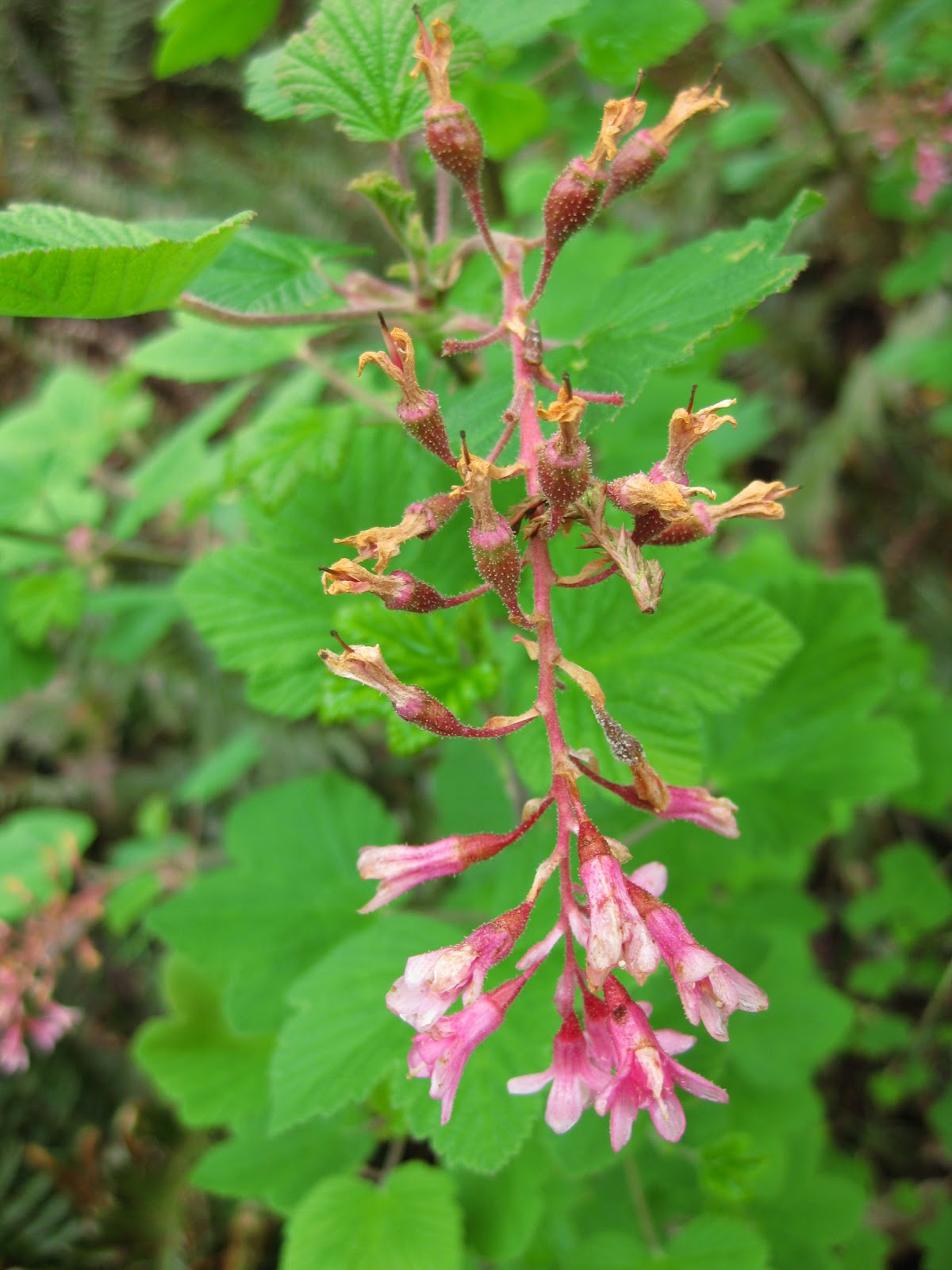
The red-flowering currant has started to develop fruits!
Cones developing on the Nootka cypress
 The knobby, segmented female cones distinctive of Alaskan yellow cedar (nootka cypress) can be seen here dominating the picture while the little male strobili stay timidly far away on the tips of the branches. These branches also provided a quick resting spot for a fly.
"Maybe I should pick a less poky tree next time..."
Looking around on the ground again, we spotted a new piece of vegetation hiding close to the ground, but with the nice, distinctive palmately lobed, rounded leaves of the genus Geranium. 

Dovefoot Geranium
Based on its small size and proximity to the ground, we identified it as Dovefoot Geranium. It is native to the Mediterranean and sub-Mediterranean areas, but is now naturalized in other parts of Europe, in southwestern and central Asia and in North Africa. It is an introduced species in North America, where it is known as Dovefoot Geranium or Awnless Geranium. While we normally think of geranium as a harmless, aesthetically pleasing flower, the plant is actually a noxious weed in the Pacific Northwest and quickly forms groundcover on open areas, among grasses, and in planting beds.
Moving back to the Bigleaf Maple, we noted the leaves appeared to be getting bigger and the catkins opening up more, preparing to fruit.
Bigleaf Maple catkin flower opens to reveal a quite whimsical pistil!
...And displaying its stamens/anthers in full force!
 The Elderberry flowers were also developing a nice white color and fully spreading open. They kind of make me think of tiny pieces of popcorn being popped...
Elderberry
Next, we found a new species called Hawthorn, in the Rosaceae family.

Note the rose hips of the Hawthorn, distinguishing it as in the Rose family!
 It was helpful that I finally learned what rose hips are this week, so I knew what to look for (they are the round, reddish to brownish balls with the sepals fringed on top). Rose hips are the fruit of the rose plant. They begin to form after successful pollination of flowers in spring or early summer, and ripen in late summer through autumn. Rose hips are used for jelly, syrup, soup, beverages, pies, bread, wine, and in teas. They can also be eaten raw, like a berry, if care is used to avoid the hairs inside the fruit. They have grown in popularity due to their high vitamin-C content, and thus rose hip tea is a common cold remedy.
This week we learned about the two common species of rose in the Pacific Northwest: Nootka rose and baldhip rose. We kept a lookout for those as well, and--fancy that!--we stumbled upon some Nootka rose, distinguished by the pinnate, compound leaves, with leaflets in 5-9 bunches and BIG curved thorns.
Nootka rose-those are the thorns your mother warned you about
Next, we saw what we can only guess was a very old mushroom. It looked a bit Dr. Suess-esque, but showed no signs of leaf growth or remnants of any reproductive structures...
Fungus...or remnant of an ancient Truffula forest?! (see below)

Maybe Dr. Suess was onto something
Then, we found some Indian Plum, which we had to check twice, since the flowers were beginning to heavily fruit.
Indian plum fruiting
On the Douglas fir, the cones were maturing. Here you can see the distinct range of phenotype between the male and female cones...
Small male cones. You know they're male when you flick them and pollen falls
Female cones (see below for distinguishing feature of the female cones)
File:Pseudotsuga menziesii cone.jpg
Douglas fir female cones have wing-like structures that
appear to dangle out of the cone
Next we saw Snowberry, also known as "corpse berry" (hope I don't have to explain the reason behind that one). It looks somewhat like Huckleberry, but while huckleberry has alternate leaves, snowberry's are opposite, and usually tinged with a little bit of red. Of course the white snowberries are usually a pretty good indicator when they are around...
Common Snowberry
 From far away, the peeling bark calls...and we find a Pacific Madrone.
Pacific Madrone
Peeling bark of the madrone

Distinct, bell-shaped flowers...must be Ericaceae!
(same family as blueberries)
We also found a plant that looked exactly like red-flowering currant, but the leaves were white. Some id-ing leads us to believe it is Sticky currant.
Sticky Currant
As we ventured further into the natural, wooded areas of the park. We found many alders lining the path, which later turned to deeply shaded evergreen areas. Where the alders abounded, many small birds could be heard flittering around in them. I tried in vain to get a picture of a chesnut-backed chickadee we saw. I managed only to snap yet another picture of the much bolder robin. He looked slightly perturbed at my presence, possibly because we tried to sneak up on him while he was bathing in a nearby puddle...
"Seriously...stop following me around"
 On the way into the wooded areas we also noted many mangled looked, warty-barked trees. The strange structure and texture of the trunks both interested and perplexed us. We spotted many that had the same strange "warts" so it was hard to determine if these were some kind of nodule growth. We will try to id them at some point. Note: we have PROOF that the sun came out for awhile in these pictures (a rare treat for the Pacific Northwest naturalist!)
Warty trees?
In this same area, we found Vinca vine growing in the alders' shade
Vinca
 A beetle resting on an alder leaf
As well as what was likely a House fly resting on some unknown shrub. We also found what we later identified as Fringecup
Fringecup
We wandered down the path into the evergreen wooded area. Within the woods we did not identify many new species, except some very conspicuous licorice ferns
Licorice ferns just hanging out
and many more sword ferns amongst the underbrush
On the way back out, I noticed a new pine with giant needles. As I came closer I noticed its needles were in bundles of 3...Ponderosa pine!
Ponderosa pine. Pom-pom shaped needle structure

A closer look revealed beautiful, majestic cone developing display.
Females on the edges and males in the middle.
We hope for Week 4 to bring us a bit more sun, as well as a chance to continue to see more change in our species phenotypes and behaviors!

Now, for a little exercise in species identification using some of the species we have found at Discovery Park:

1. Bigleaf Maple (Acer macrophyllum): Large tree species. Deciduous. Opposite light green 5-lobed palmate leaves (claw-like, hanging). Flowers form in hanging catkins and are greenish-yellow, about 3mm across. Fruits are golden-brown, paired winged seeds and the long wings that separate in a V-shape.
2. Western Red Cedar (Thuja plicata): Large evergreen conifer tree species. Leaves form in non-pointy scales. Leaves in opposite pairs in four rows in overlapping shingle assortment resembling a flattened braid. Glossy green color on leaves. Bark is reddish when mature and stringy. Reddish male cones remain very tiny on tips of branches while female seed cones are green when immature, then grow to become brown, woody and turned upwards with winged seeds.
3. Western Hemlock (Tsuga heterophylla): Large, up to 60 meters tall, evergreen tree species. Leaves in needles that are short, blunt, fat, irregularly spaced and usually unequal length (5-20mm long). Leaves are yellowish-green and top while underside is whitish with 2 fines lines of stomata. Male pollen cones numerous and small. Female cones are also quite small, 1-3cm in length.
4. Red-Flowering Currant (Ribes sanguineum): Grows in shrub form in tall, erect manner, 1-3m tall with crooked stems and reddish-brown bark. Deciduous. Leaves grow in alternate pattern and are regularly or irregularly 5-lobed and 2-6cm broad. The lower surface of the leaf is paler and hairier. Flowers are usually a deep magenta-pinkish color, though it appears the colorful petals are actually sepals, since there is a whitish rounded tubular structure that also protrudes out from the center that surrounds the stamens and pistil. The flower structure is tubular, with sepals separated into 5 parts and the flowers grow in drooping bundles of 10-20 flowers. Fruits are blue-black round berries 7-9mm and unpalatable.
5. Indian-Plum (Oemleria cerasiformis): Grows in large shrub or small tree form, 1.5-5m tall. One of the first plants to flower in the spring. Deciduous. Leaves alternate, pale green, soft and lance-shaped, 5-12 cm long. Non-serrated entire leaves that smell strongly of cucumber when crushed. Flowers are greenish-white bell-shaped and about 1 cm across. Male and female flowers grow on separate plants. Flowers have 5 petals, 15 stamens and hang in 5-10cm long clusters from leaf axils. Fruits are small and ripen from a peach to a bluish-black color with a whitish bloom and look like small plums about 1 cm long, edible but bitter with a large pit.
6. Cleavers (Galium aparine): Weak, herbaceous, tap-rooted annual. Grow low to ground, 20-100cm tall. Leaves in whorls of 6-8 linear, oblong, 1 veined structure. Have bristles on underside up leaf that will attach to fabric such as cotton and will stick to some clothing. Flowers are whitish or greenish and small, 1-2mm wide, with petals fused at the base into a very short tube that spreads into 4 lobes . Fruits are dry 2-lobed little burs covered with hooked bristles.
7. Ponderosa Pine (Pinus ponderosa): Large evergreen conifer tree species. Bark is scaly and cinnamon-colored. Leaves are distinctively long needles (compared to other pines), 10-20cm, and grow in bundles of 3 needles and branches can grow sloping downwards in mature trees. Cones grow in circular nest-like structure surrounded by a bunch of pines in a pom-pom structure. The cones grow with rows of female, oval cones on the outside and small, male cones in the center. Female cones mature from purple-brown color to brown and males become long and erect
8. Common Snowberry (Symphoricarpos albus): Grow in shrub form, erect, from .5-2m tall. Opposite branching with young hairless stems and fine twigs. Deciduous. Opposite, elliptic to oval leaves 2-5 cm long and may be lobed on young stems. Edges smooth to wavy-toothed. Flowers are pink to white, bell-shaped and 5-7mm in short dense clusters of few flowers, mostly terminal. Fruits are in clusters of white berries, 6-15mm across and are inedible to humans, though palatable to other animals such as birds.