Date: April 7, 2013
Weather: cloudy with medium rain and little wind
Temp: 46 F
Time: 3:20pm-4:20pm
Location: Discovery Park
For my first observations, I decided to venture to Discovery Park. Slightly dissuaded by the weather, I waited until the last day of the weekend, and when I decided it wasn't going to stop raining, I gathered up by rain gear and field guides and headed out with another student from class. From the parking lot, we only had to venture about 50 feet in before the irresistible urge to identify took over, though I had originally planned to wander around a lot before settling on a location for my "spot." There were a few trees and shrubs, including:
 |
| Milk thistle? |
Looking closer at the thistle, we noticed a strange collection of what appeared to be larvae of some sort covering the thistles leaves. We guessed that they may be dormant still, waiting to hatch and sink their mandibles into the juicy plant! I have one theory that this could be butterfly larvae, since monarch butterflies are known to very commonly lay their eggs and feed on milk thistle. This would also tentatively identify the plant as milk thistle. Continuing...
 |
Alaskan Yellow Cedar, which iNaturalist identifies as Nootka cypress.
Note the pointy leaves for later! |
|
|
 |
| Red-flowering currant |
|
|
|
 |
| Sword fern, still developing its shoots, located next to the currant |
 |
| Oregon Grape |
|
|
 |
| Galium aparine |
|
|
|
Though the last one does not seem particularly cool or pretty to look at since it is not currently flowering, I thought it was interesting because as I looked it up in the Audubon field guide I found that the word galium is derived from the latin
gala which means "milk," because in ancient Greece the plants compounds were used to curdle milk. Further wiki research reveals that
galium aparine leaves and stems can be cooked and eaten as a vegetable, if gathered before the flowers appear. It also has medicinal uses as a diuretic, its pulp relieves poisonous bites or stings, wounds, and burns, acts as a mild sedative, and it has been shown to lower blood pressure. Pretty good for such a little plant!
In this area, we also saw:
 |
English Holly, an invasive.
These sprigs are connected to a tree growth about 30 feet high! |
|
|
|
 |
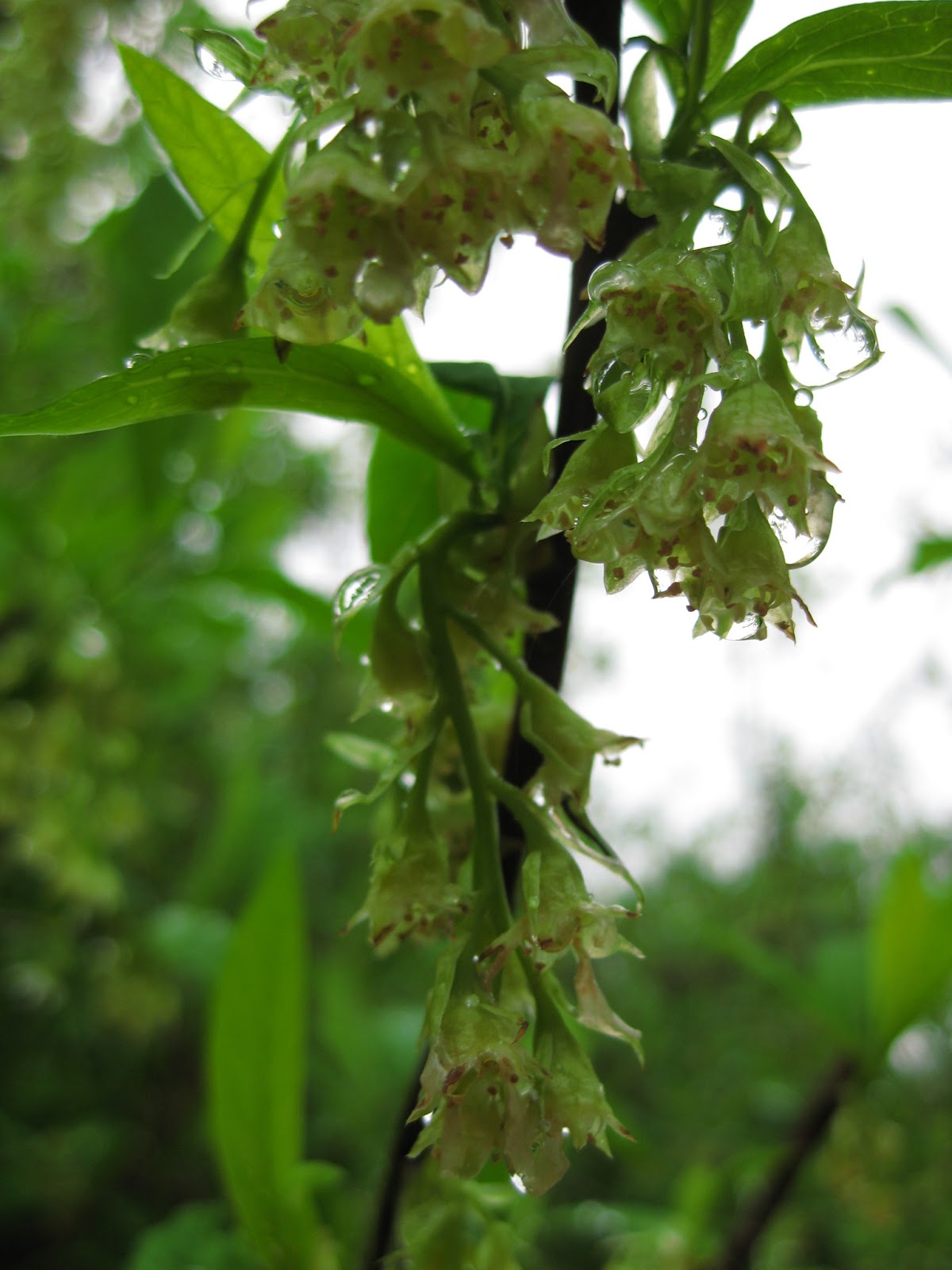
Unknown species, attempted to identify in field.
Likely in the Rosaceae family, possibly the bird cherry. |
|
The flowers above were growing abundantly in a low to the ground woody shrub structure. Both of us spent about 10 minutes flipping back and forth through our book trying to identify it. This was a prime example of learning how closely you have to pay attention to detail when trying to field id. I would think I had it, then would recheck the number of petals, the number of stamens, the leaf pattern and structure, and would then have to discard my previous conviction.
We thought that maybe next time it would be useful to
bring Ziploc bags to collect specimen samples to bring home for later identification. Also, I forgot my binoculars, so I need to remember those for when the birds come out!
Next door, we found Indian Plum and Bigleaf Maple:
 |
| Indian Plum |
 |
| Bigleaf maple, distinguishable by the palmate leaves (see below) |
 |
| Young Bigleaf Maple leaf |
Next, we ventured through the typical huge field of Himalayan blackberry, the super invasive species found everywhere. In cleared patched through the blackberry, we noticed it was overrun with clover:
 |
| Clover path through the blackberry thickets |
We continued our tree id and found Lodgepole pine, or
pinus contorta,
 |
Lodgepole pine, distinguishable by having bundles
(indicative of all pines) with two needles per bundle |
And Western Red Cedar:
 |
| Western Red Cedar |
|
|
|
Note that this cedar's leaves are much more flat and pointy than the Alaskan Yellow Cedar we saw earlier!
 |
| Some sort of cherry blossom tree? |
|
|
 |
| Unknown species of Lupine |
Lastly we noted the landscape along the main path away from the parking lot which was mostly an open field of scotch broom (an invasive legume) and several young, growing lodgepole pines that were obviously planted by the park.
After we'd gone on this plant spree, I noted that we should probably look for specimens from some of the other kingdoms. We had little luck in terms of birds, since it was raining, though we heard many calls, including the staccato, upward song of the American robin and the vibrating call of the pine siskin. We saw a few birds flittering from tree to tree here and there that appeared to mostly be different kinds of sparrow.
Before we left, though we were able to find an epic mushroom growing in the twig litter in the shade of some trees!
 |
| Unknown mushroom |
Fungi are one of the most fascinating organisms to me. Not much is
known about fungi since they are quite difficult to study, given
that the entire organism minus the fruiting body lives below-ground. One
fungus in Michigan was estimated to be the largest known single fungus
and was approximately forty acres in diameter and thought to be almost a
century old. They are more closely related to animals than plants,
mostly based on their biochemistry, since they feed on plant nutrients
just as we do. Their intimate connections with plants and soil bacteria
is still not fully understood and they can be used in bioremediation to
remove oil and other persistent organic pollutants. Basically, fungi are
fricking awesome!
We have been unable to identify it as of yet, but of course the age-old question always begs itself whenever I encounter a mushroom: "Can I eat it?" Upon closer inspection, the answer may be pointing towards a yes...
 |
| Maybe it wasn't that tasty though |
However, this looks to be about one bite's worth, which could have also been enough time for the animal to realize just the opposite! Underneath, the gills are highly pronounced and white. We will have to come back to identifying later...